Hot DLMM Pools
A live board ranking Meteora DLMM pools by realized fees per dollar of liquidity in the traveled price range: where LP capital is actually getting paid, right now.
Table of Contents
What the board ranks
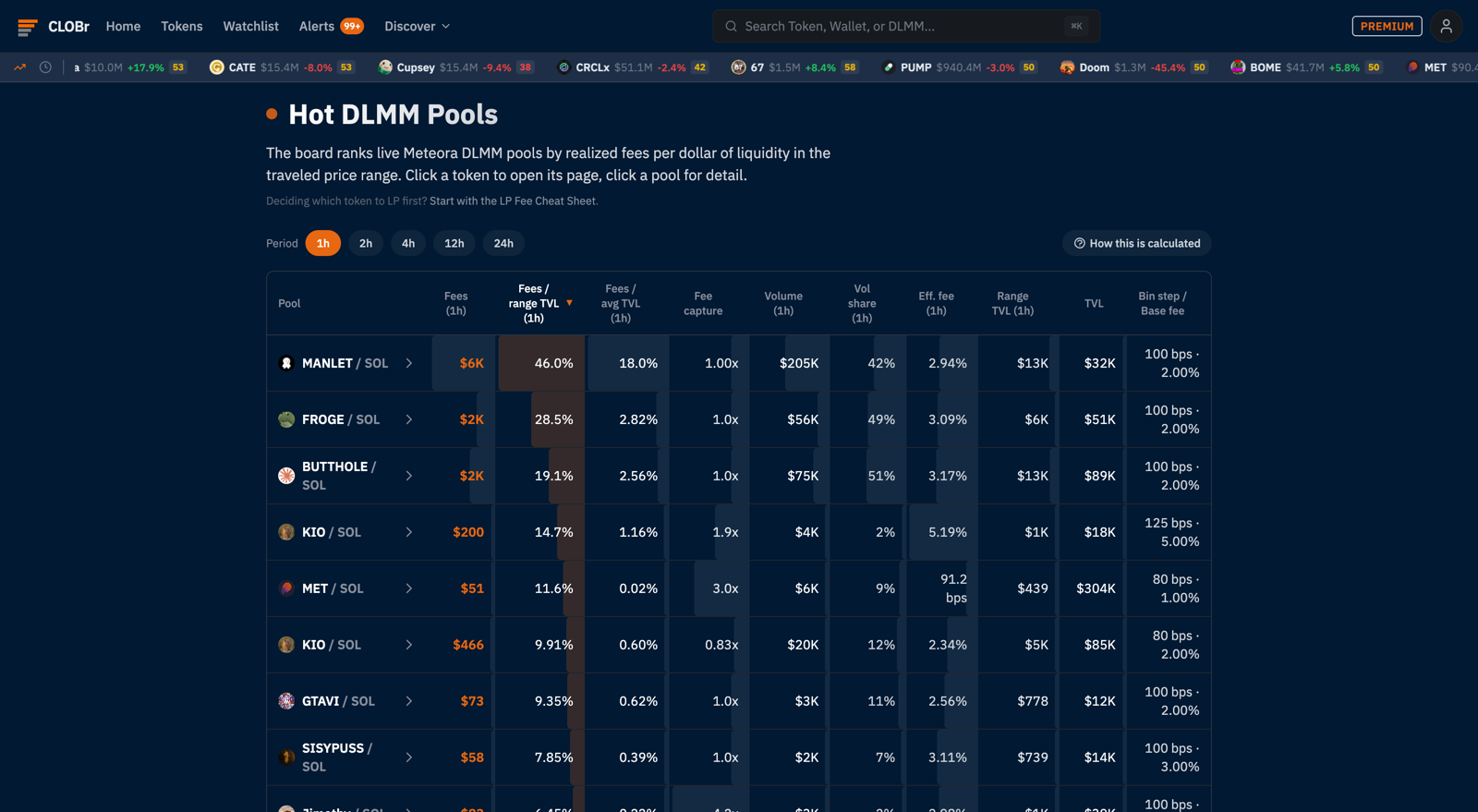
clobr.io/dlmm ranks live Meteora DLMM pools by realized fees per dollar of liquidity in the traveled price range. Not advertised APR, not raw volume: fees that were actually collected, divided by the TVL that was actually positioned where price went.
This kills the two classic DLMM traps in one number. Trap one: the high-volume pool with so much TVL that your share of fees rounds to zero. Trap two: the high-APR pool where the advertised rate came from one violent hour that already ended. Fees / range TVL over a window you choose is what a dollar in the right bins actually earned.
Every column, explained
| Column | Meaning |
|---|---|
| Fees | Dollar fees the pool collected in the selected period. |
| Fees / range TVL | The ranking metric. Fees divided by the TVL inside the price range the pool actually traveled this period. 46% over 1h means a dollar in the traveled bins earned 46 cents that hour. |
| Fees / avg TVL | Fees divided by the whole pool's average TVL. The gap between this and the range figure is concentration opportunity: a wide gap means most of the pool's capital sat outside the action, and a well-placed range dramatically out-earns the pool average. |
| Fee capture | Collected fees vs what volume x fee tier implies. ~1x normal; >1x means thin competition in the traveled bins; <1x means volume leaked to sibling pools. |
| Volume / Vol share | Period volume through this pool, and its share of all volume on the token. High vol share = the canonical pool; low = a side pool that may still pay via a higher fee tier. |
| Eff. fee | The effective fee rate actually paid by traders in the period, including Meteora's dynamic fee on top of the base. When eff. fee runs far above base, volatility is being monetized for LPs. |
| Range TVL / TVL | Liquidity inside the traveled range vs the whole pool. A $13K range TVL in a $32K pool means less than half the capital competed for the fees. |
| Bin step / Base fee | The pool's structure: price gap between bins (bps) and its base fee tier. Wider bin steps and higher base fees suit volatile tokens; see Bin Ranges and Price Impact. |
Choosing a period
The period toggle (1h / 2h / 4h / 12h / 24h) changes the question. Short windows answer "where is the action right now" and suit active LPs who re-range intraday. 12h and 24h answer "what has been paying all day" and suit set-and-monitor positions. A pool that ranks high on both 1h and 24h is the strongest signal: sustained flow, still live.
How LPs use it, novice to expert
Novice: shortlist, then verify
Open the 24h view, note the top five pools, and click each token to check its depth chart and audit score. A pool paying 20% a day on a token with no support liquidity is bait: the fee yield will not cover the drawdown when the bid side vanishes. Yield never outruns a rug.
Intermediate: read capture and the range gap
Prefer pools where fee capture is at or above 1x and range TVL is a small fraction of total TVL. That combination means the traveled bins are under-supplied: your concentrated position joins thin competition for real flow. Then open the pool detail and the token's DLMM Pools tab to see where incumbent LPs are ranged.
Expert: structure arbitrage across sibling pools
When one token has several pools, the board shows them separately (same token, different bin step and fee tier). Volume concentrates in the canonical pool, but the higher-fee sibling sometimes earns more per dollar on the volume it does get; the eff. fee and fee capture columns make that visible. Simulate your exact range with the LP Simulator before deploying.
Where this fits
Deciding which token deserves LP capital? Start with the LP Fee Cheat Sheet, which ranks tokens ecosystem-wide. This board answers the next question: which pool on that token, and what structure. Pool-level deep dives live in DLMM Pool Analysis.