LP Fee Cheat Sheet
Which tokens could earn LPs the most fees per pooled dollar: real organic volume against the ecosystem-wide concentrated liquidity near price.
Table of Contents
The idea: fees per pooled dollar
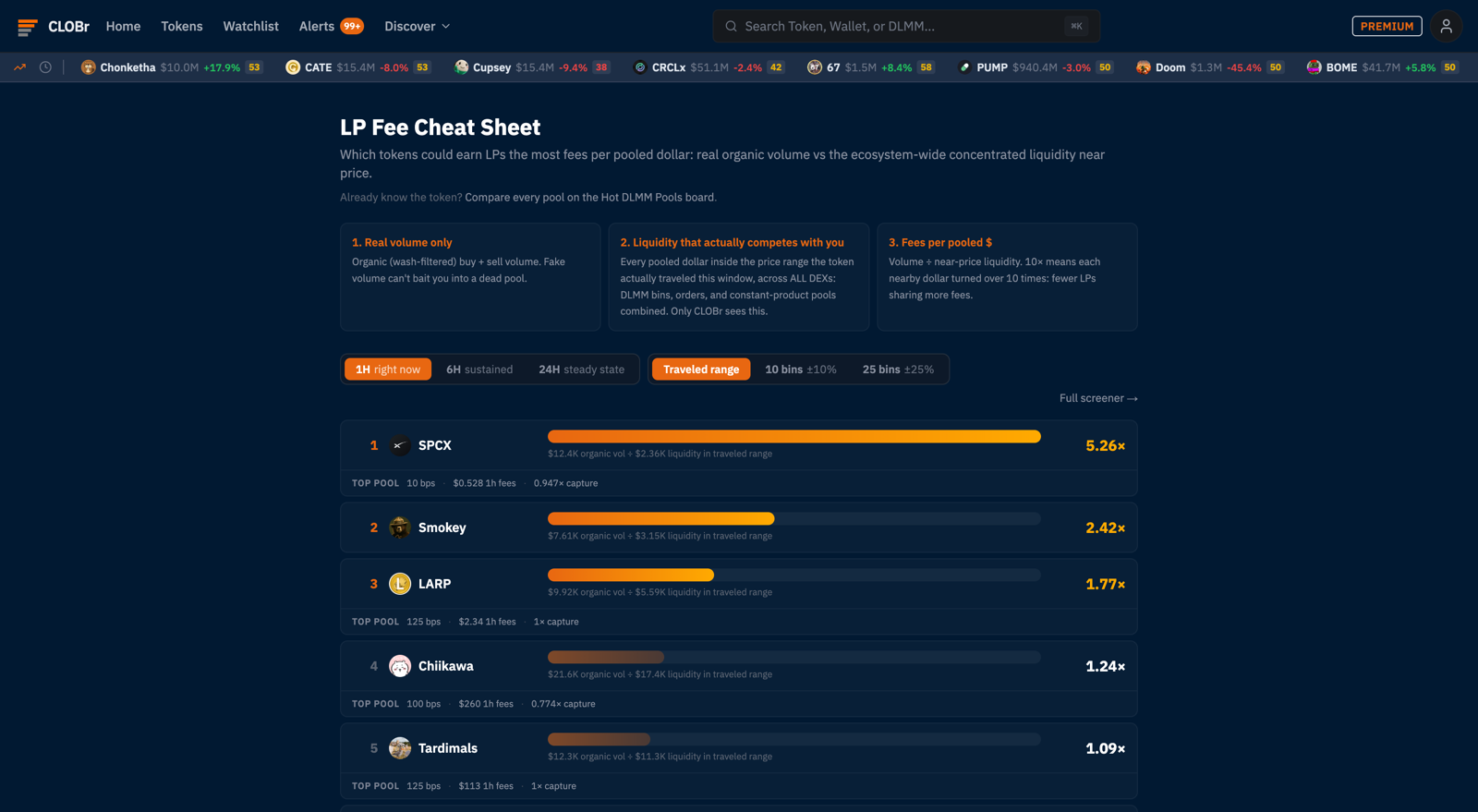
LP returns are a fraction: fee flow over the liquidity sharing it. Most LPs only ever look at the numerator (volume, APR banners). The LP Fee Cheat Sheet computes the whole fraction across the ecosystem: real volume divided by the liquidity that actually competes with you near price, per token. The result reads as a turnover multiple: 5.26x means each nearby dollar turned over five times in the window.
The three-step method
- 1. Real volume only. Organic (wash-filtered) buy + sell volume. Fake volume cannot bait you into a dead pool.
- 2. Liquidity that actually competes with you. Every pooled dollar inside the price range the token traveled, across ALL DEXs: DLMM bins, resting orders, and constant-product pools combined. A Raydium pool competes for the same swaps your Meteora bins do; counting only one venue flatters the ratio.
- 3. Fees per pooled $. Volume ÷ near-price liquidity. Higher = fewer LPs sharing more fees.
Windows and denominators
Two toggle groups control the question you are asking:
- Window: 1H "right now", 6H "sustained", 24H "steady state". Rank by 1H to chase live flow with active re-ranging; rank by 24H for positions you will not babysit.
- Denominator: Traveled range (liquidity where price actually went; the honest measure of what a tight active range experienced), 10 bins ±10% (a tight passive range), or 25 bins ±25% (the standard passive LP range). Tokens that rank high on traveled range but low on ±25% are volatile movers: great for active LPs, punishing for passive ones.
Reading a row
Each row shows the ratio bar with its inputs spelled out ("$12.4K organic vol ÷ $2.36K liquidity in traveled range = 5.26x") plus a TOP POOL line: the leading pool's fee tier (bps), its realized fees in the window, and its capture ratio: the share of the token's fee opportunity that pool actually collected. Capture near 1x means the top pool is where the action settles; low capture means fees are split across venues and pool choice matters more than token choice.
From cheat sheet to position
Novice
Use 24H + ±25% band. This is the closest to "set a normal range and hold." Before depositing anything, open the token page: check audit score and support liquidity. High turnover on a token that can rug is not yield, it is exit liquidity with extra steps.
Intermediate
Compare a token's 1H against its 24H ranking. 1H far above 24H is a fresh volume burst (enter small, re-range often); 24H above 1H is flow cooling off. Then follow the row into Hot DLMM Pools to pick the specific pool and structure.
Expert
Work the denominator gap. A token ranking 4x on traveled range but 0.8x on ±25% tells you exactly where the fees live: in a tight band around price that most LPs are too wide to occupy. Model that tight range in the LP Simulator, check the token's own Liquidity Ratios matrix for percentile context, and set an alert so you know when the flow stops.
The pipeline
Cheat Sheet (which token) → Hot DLMM Pools (which pool) → DLMM Pool Analysis (which range) → LP Simulator (what it earns) → Alerts (know when to leave).